Women as coders
We were there from the start
In the April 1967 issue of Cosmopolitan magazine, there was a little essay called "The Computer Girls".
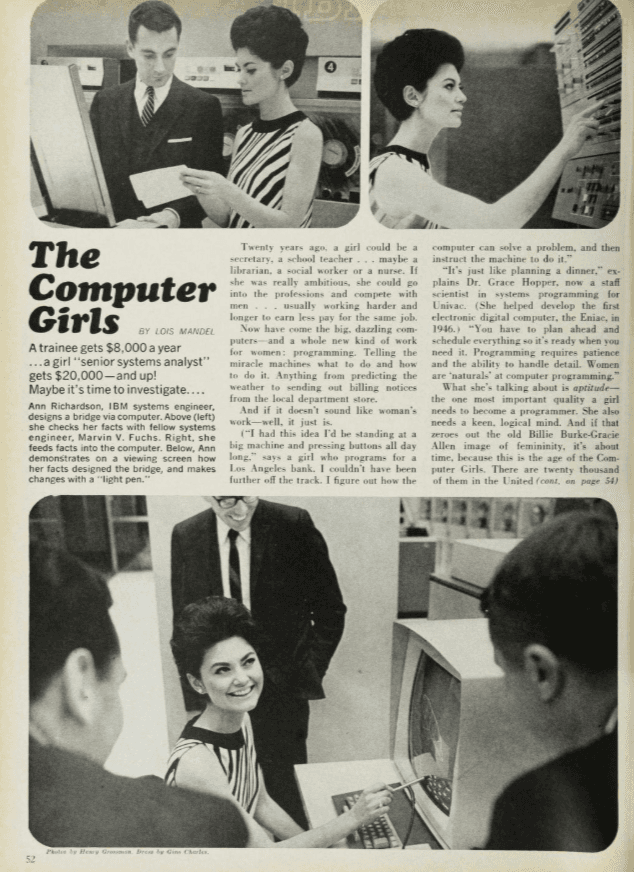
Now have come the big, dazzling computers—and a whole new kind of work for women: programming. Telling the miracle machines what to do and how to do it. Anything from predicting the weather to sending out billing notices from the local department store. And if it doesn't sound like woman's work—well, it just is.
"I had this idea I'd be standing at a big machine and pressing buttons all day long," says a girl who programs for a Los Angeles bank. "I couldn't have been further off the track. I figure out how the computer can solve a problem, and then instruct the machine to do it."
"It's just like planning a dinner," explains Dr. Grace Hopper, now a staff scientist in systems programming for Univac. (She helped develop the first electronic digital computer, the Eniac, in 1946.) "You have to plan ahead and schedule everything so it's ready when you need it. Programming requires patience and the ability to handle detail. Women are 'naturals' at computer programming."
What she's talking about is aptitude—the one most important quality a girl needs to become a programmer. She also needs a keen, logical mind. And if that zeroes out the old Billie Burke–Gracie Allen image of femininity, it's about time, because this is the age of the Computer Girls.
As is mentioned in the article⤴, coding was thought of as a "routine and mechanical" activity, which was supposed to be perfect for women.
The Cosmo article didn't get everything right as Ensmenger⤴ writes, although it portrays the confusing and contradictory messaging about the role of women in programming. Women played a critical role in early computing, especially computer programming. The first algorithm intended to be executed by a computer was designed by Ada Lovelace who was a pioneer in the field. Grace Hopper was the first person to design a compiler for a programming language.
However, in the late 1960s the programming community was actively making itself more masculine. There were still significant breakthroughs made by women, such as the Harvard computers and engineering at NASA. But the computing work evolved into modern, personal software, and this lead to a huge need for more programmers. Competition for skilled programmers drove up salaries and women were able to move into fields from which they might otherwise have been excluded.
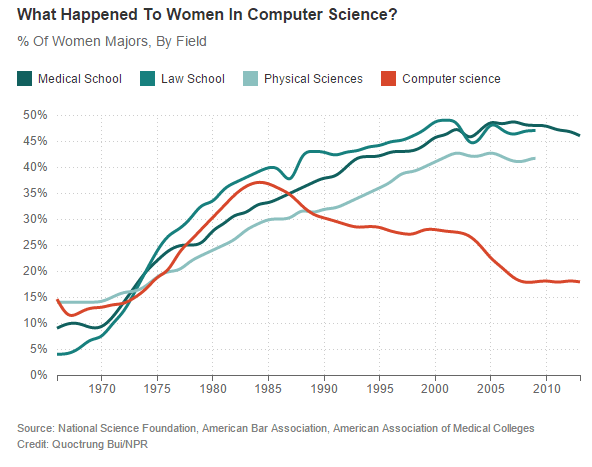
The exact skill set needed for programming was vague at the start, but it was assumed to be at least somewhat mathematical. As the group of programmers grew, so were the formal programs and studies, certification programs, and standardized development methodologies. In a series of papers published in academic journals, SDC psychologists Dallis Perry and William Cannon provided a detailed profile of the interests of computer programmers. What they found is that most programmers enjoy their work, dislike routine and regimentation, and are especially interested in problem and puzzle-solving activities. This is very similar to other white-collar professionals. The one distinct thing they found is that programmers prefer to work with things rather than people. This lead to the lore that computer programmers lacked people skills. Interviewers started to focus more and more on this trait of strong independence and a slightly neurotic behavior during job interviews, which already starts leaning more towards stereotypically masculine characteristics.
Perhaps this idea of what a coder is lead to a self-fulfilling prophecy. You could of course debate whether this personality is an accurate reflection and whether gender discrimination is a function of biology. Another interpretation is that gender discrimination is in this case a function of a historical accident, where the selection mechanism on this personality type turned to overpresent males.
Naturally there are more reasons to this complex change in how many women or men are in the coding field. Because of the huge demand for workers and the fact that women are less likely to want to move or travel far for a job, employers hired more men. Women also suffered because advertisements showed them as low-skill, low-wage labor. As more professional standards were raised, it was difficult for women to enter the profession because there were a lot less women in college or university during this time.
According to Ensmenger, the masculinization of programming was not a single deliberate act of exclusion, but a combination of structural and cultural shifts that reinforced each other. The job field narrowed it open gates that were there at the start by becoming more professional. The nerdy stereotype that we now all associate was already taking shape. What feels like "the way it's always been" turns out to be historically contingent. The same goes for the way coders love to tend to work at night. This was caused by early batch-processing schedules which forced programmers to work during the night to access the machine.
Looking back at "The Computer Girls", it clearly shows that the world of computer programming was once genuinely open. The story of women in computing is not one of a closed door that was slowly pried open, but of an open door that was gradually closed — and then forgotten.
Women as subjects
More coming soon on this topic, but I already want to refer to the Lenna image data essay⤴ from pudding.