The Indie Web is a movement⤴ and a set of principles that advocate for individuals to own their online presence, rather than relying on centralized platforms like social media sites. The core idea is to create a web where people can publish content, connect with others, and maintain control over their data.
As Jon Bo mentions in his post Digital Cities⤴:
This in contrast to the quieter, messier parts of the internet. Spaces not designed from scratch - but instead grown over time by countless passers-by; some of whom decided to add a sentence or a page, some css, or just browse and make an appearance in the guests-online indicator in the footer. Born in a weekend and kept alive by love and bubble gum; these are the alleyways of the internet.
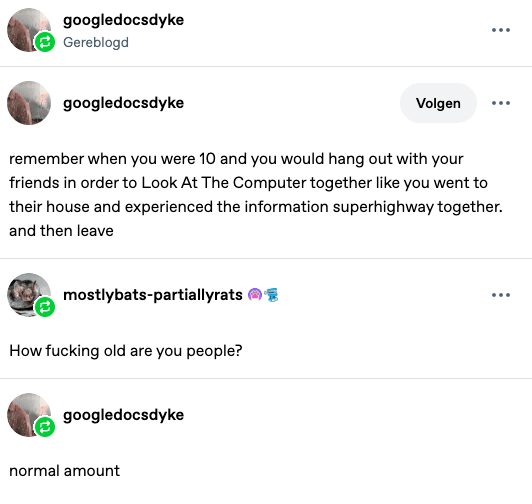
It's an antidote to the large social media platforms where an algorithm decides what content you see. The platforms where there's a never-ending stream of content design to keep you everlasting scrolling. The infinite scroll was invented to make browsing smoother, but it is now something that has people addicted to their phones screens for hours and hours.
The internet has been overdeveloped and undergoverned.
The feeling of the old internet
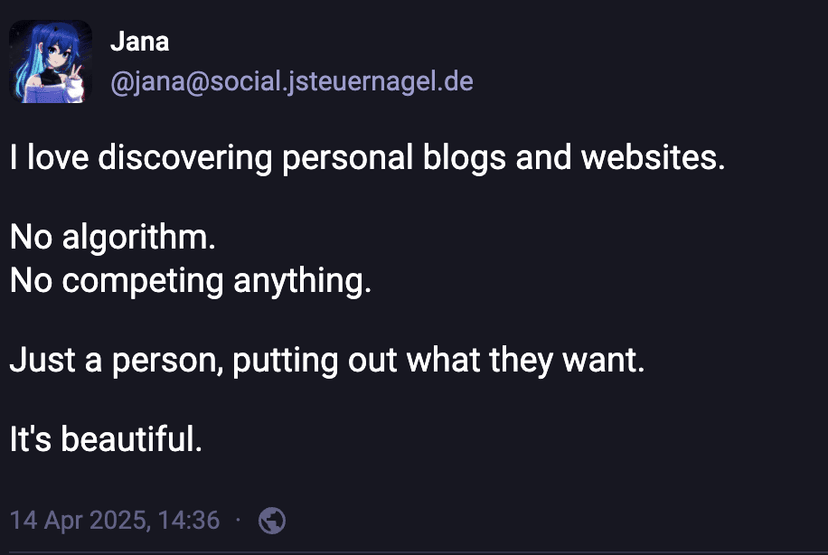
The internet can also be a place to make friendships with people all over the world, which is especially wonderful because you can connect over niche interests that people in your real-life surroundings might not get. The internet can also be a place to learn more about your specific interests and hobbies. No ads spamming your view, but long-form blogs where people go in-depth about their set-up without the goal of monetizing your attention.
How did the internet become messy and tiring?
In the book Tools For Conviviality, technology philosopher and social critic Ivan Illich identifies two things as the reason why we might not experience the internet like we used to: the optimistic arrival of the internet at the start, and the industralization asa it became more popular. The internet started as a tool for creativity, ideas and automation, but with the industrialization the tool has become so popular that people cannot not use it anymore. We are basically excluded from society, or the "normal ways of doing things", if we don't use the internet. Or social media, for example.
Also, a lot of the businesses that make up a large part of where we 'are' on the internet are going through the enshittification process where they get too dependent on ads or investors for their profit.
The core of the internet
In order to get an idea about how the "old" internet is still here, we need to look at what the internet consists of. Terry Godier has a really nice visual essay⤴ about how the internet is set-up The internet consists of platforms, services and protocols.
Platforms, like Instagram, TikTok and Substack, are the most dominant because of the commercial opportunity. The platforms we know are very visible to everyone.
Underneath those platforms, there are services: companies that own infrastructure. Think of Gmail, Github, AWS, CloudFlare, etc. These are also commercial and powerful in their own way, but this is not where your social daily life happens.
Underneath services, we can find the protocol layer. These protocols have been there for a very long time, like before 1980, and these were designed to solve specific problems, without the intention of selling anything. Examples of protocols are HTTP, SSH, RSS; all things that enable things for us on the internet. Sending each other stuff, having some kind of feed where we can see new content, and loads more of these interactions. These are public and ad-free and could be called boring.
These protocol technologies are boring because they are useful without any cool hype around it. They just work. No one can sell these, and they are too federated to centralize. What this means is that we are not dependent on the platforms that are currently all the hype. We can move towards tools that work for us.
The end-goal
That's exactly what I love seeing happen on the internet at the moment. People creating thinks differently. No massive platforms, but smaller, cozier things that make us happy and interested and smart.
The Internet was never promised to be open, free, or modifiable. Born in the U.S. military and courted by several private companies, it could have easily been seized by a single entity. Instead, many brave people fought to keep it open to everyone, collectively stewarded by many, and owned by no one.
We can shape these internets together, piece by piece. We can make our own public parks, cafés, bodegas, waterfalls, and mountains. We can take care of them, not as users, but as stewards maintaining a home for generations to come. (The Internet has no benches⤴ by Spencer Chang)
References
- Index of articles The internet used to be fun⤴
- The Boring Internet⤴ by Terry Godier
- A Website to Destroy All Websites⤴ by Henry Desroches
- The Internet has no benches⤴ by Spencer Chang